Call Us Today!
(970) 247-2677
New Patients
(970) 233-7384


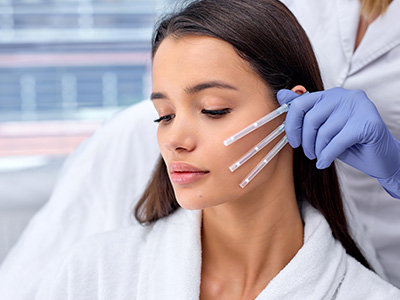
A PDO thread lift offers a middle ground between topical skin treatments and full surgical facelifts. Using fine, absorbable threads placed beneath the skin, the procedure repositions soft tissues and restores a firmer contour with minimal downtime. Many people choose this approach because it can address early to moderate skin laxity while preserving natural facial movement and expression.
Rather than replacing lost volume with synthetic fillers alone, thread lifts combine mechanical support and biological stimulation. The immediate effect comes from the threads’ lifting action; a cascade of collagen formation follows, gradually improving texture, tone, and resilience. For people wanting a refreshed appearance without major surgery, this dual action is often the most appealing feature.
Performed thoughtfully, a thread lift is designed to enhance your features—not to alter them. The goal is a refreshed, more youthful look that still reads as you. At Mountain Health Dentistry, we emphasize conservative, tailored results that align with each patient’s facial anatomy and aesthetic goals.
PDO stands for polydioxanone, a polymer long used in dissolvable surgical sutures. In thread lift treatments, PDO is fashioned into smooth or barbed threads that provide temporary structural support beneath the skin. Over time the material safely dissolves, but while it remains it offers an internal scaffold that lifts and repositions soft tissue.
Beyond the immediate lift, the presence of the thread triggers a controlled wound-healing response. Fibroblasts deposit new collagen fibers around the thread’s path, gradually strengthening the treated area. This collagen remodeling is why improvements can continue for months after the procedure and why many patients see a durable enhancement in skin quality.
Providers choose different thread types and patterns based on treatment goals. Smooth threads are often used to stimulate collagen and improve skin texture, while barbed or cogged threads provide stronger mechanical lifting. A careful assessment determines the appropriate materials and placement strategy for a safe, effective outcome.
It’s also worth noting that PDO threads are designed to be biocompatible and predictable in how they dissolve. Understanding the timeline—immediate lift, ongoing collagen development, then gradual material absorption—helps set realistic expectations about when and how results evolve.
PDO threads are versatile. Common treatment zones include the midface and cheeks for restoring a youthful contour, the jawline to address jowl formation and improve definition, and the neck to reduce mild banding and sagging. Threads can also be used more locally to soften nasolabial folds, lift the brow, or provide subtle enhancement to the lip border.
Outcome expectations should be individualized. For someone with early laxity, a thread lift can create noticeable and natural-looking improvement that may delay the need for more invasive surgery. For those with moderate signs of aging, threads are often used in combination with other modalities—such as neuromodulators, dermal fillers, or skin-resurfacing treatments—to achieve a balanced result.
Because PDO threads both reposition tissue and encourage collagen, patients typically notice an immediate change with continued refinement over the following weeks. Results vary based on factors like the thread type, placement pattern, skin quality, and the patient’s own regenerative response.
Your provider begins with a comprehensive consultation to evaluate facial structure, skin condition, and medical history. This discussion clarifies aesthetic goals and helps determine whether PDO threads are the best option or whether a combined approach would better address the concerns. Clear communication about expectations and recovery is an essential part of planning.
On the day of treatment, the targeted area is cleansed and numbed using topical or local anesthesia to keep the experience comfortable. Threads are then inserted through tiny entry points with a needle or cannula and positioned to achieve the planned lift. The procedure is typically completed in under an hour for most treatment zones, though more extensive cases may take longer.
After placement, small sutures or steri-strips may be used at entry points, and you’ll receive tailored aftercare instructions. Swelling and mild bruising are common in the first few days and usually subside within one to two weeks. Most people can return to normal activities quickly, with only a brief period of avoiding strenuous exercise and heavy facial manipulation.
Follow-up visits allow the clinician to assess healing and the evolving results. Because threads stimulate collagen gradually, many patients find their appearance continues to improve over the next two to three months as tissue becomes firmer and more refined.
PDO thread lifts have a favorable safety profile when performed by trained clinicians who follow established protocols. Risks are uncommon but can include transient asymmetry, palpable thread ends, minor infection, or temporary dimpling; most of these issues are manageable with conservative measures or brief follow-up care. Proper technique and an individualized plan are the best safeguards against complications.
Not every patient is an ideal candidate for threads. People with severe skin laxity, very thin skin, or significant excess volume may be better served by surgical options for more predictable, long-lasting structural change. Conversely, those seeking subtle rejuvenation or wanting to delay surgery often find threads to be an effective intermediate solution.
An honest assessment of goals, combined with a discussion of alternatives—such as fillers for volume restoration or energy-based skin tightening for texture—helps determine the most appropriate path. The emphasis should always be on achieving a natural, harmonious outcome rather than an overly aggressive correction.
When performed with care and clear expectations, PDO threads can be a reliable option to refresh facial contours, improve skin quality, and support a more youthful appearance. If you’re considering this treatment, a consultation will clarify whether it aligns with your needs and aesthetic objectives.
In summary, PDO thread lifts offer a minimally invasive way to lift and rejuvenate without the downtime or commitment of surgery. Mountain Health Dentistry provides thoughtful, anatomy-driven treatments that prioritize natural results and patient comfort. Contact us to learn more or to schedule a consultation with our facial aesthetics team for personalized guidance and next steps.
PDO threads are thin, absorbable sutures made from polydioxanone that clinicians place beneath the skin to provide mechanical support and stimulate tissue remodeling. The threads may be smooth for collagen stimulation or barbed/cogged for stronger lifting, and they act as a temporary internal scaffold while fixed in strategic vectors. Placement repositions soft tissue immediately and initiates a controlled healing response that encourages new collagen deposition around the thread tract.
Over weeks to months the newly formed collagen gradually firms and refines texture, while the PDO material itself dissolves predictably by hydrolysis. Because the procedure combines an immediate lifting effect with longer-term biological improvement, patients often notice both instant and progressive refinement in treated areas. Understanding that outcome evolves over time helps set realistic expectations for when full results will be visible.
Good candidates are patients with mild to moderate skin laxity who want a noticeable but natural lift without going to surgery, and who have realistic expectations about results and longevity. Ideal candidates generally have sufficient skin thickness to hold threads and do not have severe excess tissue or significant volume loss that would require surgical correction or extensive filler. A medical history review is important because certain conditions and medications—such as active infection, bleeding disorders, or recent isotretinoin use—can make thread placement inappropriate.
A consultation with a qualified provider assesses facial anatomy, skin quality, and aesthetic goals to determine candidacy and plan the correct thread types and vectors. If threads are not the best standalone option, the clinician can discuss complementary or alternative approaches such as fillers, energy-based skin tightening, or referral for surgical evaluation. Clear communication about benefits, limitations, and recovery is key to a successful treatment decision.
PDO threads provide a mechanical lift and stimulate collagen rather than primarily replacing lost volume like dermal fillers do, so their immediate effect emphasizes repositioning and contour rather than volumization. Fillers are most effective for restoring lost volume and smoothing deep wrinkles, while threads are better suited to lifting sagging tissue and improving structural definition such as the jawline and midface. A surgical facelift offers the most dramatic and long-lasting structural change by excising and repositioning tissue, which is typically recommended for advanced laxity or when definitive results are desired.
Because each modality has distinct mechanisms and outcomes, providers often recommend a tailored plan that may combine threads, fillers, and neuromodulators for balanced rejuvenation. The choice depends on the patient’s anatomy, preferences about downtime and invasiveness, and the longevity of results desired. A conservative, anatomy-driven approach prioritizes natural movement and proportional improvement rather than aggressive correction.
PDO threads are versatile and commonly used in the midface and cheeks to restore lift and reduce flattening, along the jawline to improve definition and reduce jowls, and in the neck to address mild banding or laxity. Threads can also be placed in more focused areas to soften nasolabial folds, elevate the brow, or refine the perioral region and lip border when appropriate. Treatment planning considers skin quality, underlying support, and the vectors needed to achieve a harmonious lift.
Selection of thread type and placement pattern is tailored to the treatment zone; barbed or cogged threads are favored where greater lift is required, while smooth threads are chosen to stimulate collagen and improve surface texture. Not every area is appropriate for every patient, so a clinician’s assessment determines the suitability and safety of treating a particular zone. Combining threads across multiple regions can create coordinated improvement while maintaining natural facial expression.
The consultation begins with a detailed history and facial assessment to identify goals, evaluate skin and tissue quality, and review contraindications. The clinician will explain recommended thread types, placement vectors, and expected outcomes, and will discuss aftercare and follow-up so you know what to expect before scheduling. Clear photo documentation and a discussion of alternative or adjunctive therapies help set realistic expectations for results and recovery.
On the day of treatment the area is cleansed and anesthetized with topical or local anesthesia to maximize comfort, and threads are inserted through tiny entry points with needles or cannulas according to the treatment plan. The procedure commonly takes under an hour for localized areas, though more extensive lift patterns may require additional time. After placement, entry sites may be closed with steri-strips or small sutures and patients receive specific postprocedure instructions for the first days and weeks.
Immediate recovery usually involves mild swelling, tenderness, and occasional bruising that peak within the first 48–72 hours and typically improve over one to two weeks. Patients are advised to avoid strenuous exercise, heavy lifting, and intense facial massage for roughly one to two weeks, and to sleep with the head elevated to reduce swelling. Gentle facial hygiene and following the clinician’s wound-care guidance for entry points help minimize infection risk and support uncomplicated healing.
Normal activities can often be resumed quickly, but patients should avoid pressure or forceful manipulation of treated tissues while collagen organizes around the threads. Follow-up visits allow the provider to assess healing, address any concerns such as palpable thread ends or minor asymmetry, and document progressive improvement as collagen develops over the coming months. Prompt communication with the clinic is important if unexpected pain, increasing redness, or other concerning signs appear.
When placed by an experienced clinician using aseptic technique, PDO thread lifts have a generally favorable safety profile, but like all procedures they carry potential risks. Common, usually transient issues include bruising, swelling, mild asymmetry, and palpable thread ends; these are frequently managed conservatively and often resolve without invasive intervention. Less common complications can include localized infection, thread migration, or skin dimpling, and these situations may require additional office-based correction or thread removal in rare cases.
Careful patient selection, precise placement technique, and appropriate aftercare minimize complication risk and improve the likelihood of a satisfactory outcome. A thorough preprocedure review of medical history and medications—especially anticoagulants and agents that affect wound healing—helps reduce preventable issues. Patients should be counseled on signs that warrant prompt follow-up so problems can be identified and treated early.
Initial lifting effects are immediate, while progressive improvement from collagen remodeling typically continues for two to three months; many patients enjoy visible benefits that last from several months up to one to two years depending on thread type and individual factors. Smooth threads that primarily stimulate collagen may offer more gradual textural improvement, whereas barbed threads provide more noticeable structural support that can sustain contour for a longer period. The absorption timeline of PDO material by hydrolysis also influences how long the mechanical scaffold remains in place.
Longevity is affected by the patient’s age, skin quality, degree of laxity, lifestyle factors such as sun exposure and smoking, and whether complementary treatments are used to maintain results. Periodic maintenance treatments—whether repeat threading, filler touch-ups, or skin-quality procedures—can extend overall aesthetic benefit and help preserve outcomes over time. A personalized follow-up plan developed with your clinician helps set expectations for when additional treatments may be appropriate.
Yes, PDO threads are often combined with other modalities to achieve balanced, natural-looking rejuvenation; common adjuncts include neuromodulators to relax dynamic lines, dermal fillers to restore volume, and skin-resurfacing or energy-based treatments to improve texture and tone. Sequencing matters: for example, threads are frequently placed first when the goal is structural repositioning, with fillers or lasers timed before or after based on healing and the clinician’s protocol. A coordinated plan reduces the risk of interference between treatments and optimizes the overall aesthetic result.
Your provider will develop a treatment timeline that accounts for healing intervals and the mechanisms of each modality so combined therapies complement rather than compete with one another. Discussing prior procedures, current skincare, and long-term goals during the consultation ensures safe integration of multiple approaches. When combined thoughtfully, multimodal treatment can address volume, laxity, and surface quality in a comprehensive way.
Preparation begins with an honest medical history and a review of medications or supplements that increase bleeding risk, such as aspirin, NSAIDs, or certain herbal products; your clinician will provide specific instructions about when to pause these agents if appropriate. Avoiding smoking and minimizing alcohol in the days before and after treatment supports healing, and arranging a gentle recovery period with limited strenuous activity will help reduce the chance of complications. Bring any relevant medical records or photos of concerns to the consultation to aid a focused assessment.
During your consultation, ask about the provider’s training and experience with thread lifts, the types of threads they use, expected timelines for recovery and visible results, and their plan for managing potential complications. It is also appropriate to request before-and-after photos of representative cases and a clear explanation of follow-up care and when to schedule touch-up treatments if needed. If you choose to proceed, the practice staff can outline logistical details for the appointment and answer administrative questions; Mountain Health Dentistry’s team emphasizes anatomy-driven planning to help patients make informed choices.